20 Minutes - 23 Questions
Directions: Following are 4 passages and
then questions that refer to each passage. Choose the best answer to each question and blacken the
corresponding oval on your answer grid.
|
|
|
Passage 1In the pole vault, the pole acts to convert
the energy generated by an athlete running down arunway into a force that lifts the athlete over a
crossbar. The most advanced vaulters use stiff poles that quickly convert the horizontal energy into
the lifting force. Beginning vaulters are not strong, fast, or skillful enough to bend a stiff pole
as needed to generate substantial vertical lift. Beginning vaulters must use more flexible
poles. To test the suitability of two materials for use in poles, scientists subjected three
miniature poles to two laboratory tests. Pole No. 1, made of fiberglass, is 50 cm long, with a
diameter of 1 cm and amass of 1 kg. Pole No. 2, also made of fiberglass, is also 50 cm long but has a
diameter of 1.5 cm and amass of 2.25 kg. Pole No. 3, made of carbon fiber, is 50 cm long, 1.5 cm in
diameter, and has a mass of 1kg.
Study 1Scientists tested the three poles to
determine how much force is required to bend the poles to an 85-degree angle. Table 1 shows the
results. Study
2Scientists bent each pole to an 85-degree angle and then allowed the pole to snap back to a
straight position. Table 2 shows the time required for each pole to snap back.
|
|
|
1.
|
According to the results, what is the relationship between the force required to
bend a pole and the time needed for the pole to snap back to its regular position?
A. | The greater the force required to bend the pole, the more time required for the pole
to snap back. | C. | For only the fiberglass poles, the greater the force required to bend the pole, the
more time required for the pole to snap back. | B. | The greater the force required to bend the
pole, the less time required for the pole to snap back | D. | For only the fiberglass poles, the greater the
force required to bend the pole, the less time required for the pole to snap
back. |
|
|
|
2.
|
On the basis of Study 1, what is the relationship between pole mass and
stiffness?
A. | The greater the mass, the stiffer the pole. | C. | The less the mass, the stiffer the
pole | B. | For a fiberglass pole, the greater the mass, the stiffer the
pole. | D. | Mass and stiffness
have no relationship. |
|
|
|
3.
|
Which of the following is a controlled variable in this study?
A. | pole diameter | C. | time for poles to return to vertical | B. | force required to
bend poles | D. | force generated
when poles return to vertical |
|
|
|
4.
|
Kinetic energy results from the actual motion of an object, while potential
energy is a measure of the energy that results if an object moves from a certain location. During a
pole vault, at which times is virtually all the energy in the form of potential energy?
A. | when the vaulter is running down the runway | C. | as the pole unbends and sends the
vaulter upward | B. | when the pole is bent | D. | as the vaulter falls into the pit |
|
|
|
5.
|
Ideally, vaulters like to use long poles becaus the poles reach closer to the
crossbar. If a pole is too long, though, a vaulter has difficulty carrying it down the runway because
of its mass. Given these considerations, which material is best suited for a very long pole?
A. | Fiberglass, because it snaps back relatively slowly. | C. | Carbon fiber, because it’s
hard to bend. | B. | Fiberglass, because it has a relatively high mass-to-volume
ratio. | D. | Carbon fiber,
because it has a relatively low mass-to-volume ratio. |
|
|
|
6.
|
On the basis of the entire study, which poles, if they were proportionately
enlarged for use by a vaulter, are most appropriate for a beginning and experienced vaulter,
respectively?
A. | Pole No. 1, Pole No. 2 | C. | Pole No. 1, either Pole No. 2 or
Pole No. 3 | B. | Pole No. 1, Pole No. 3 | D. | Pole No. 2, Pole No. 3 |
|
|
|
Passage 2Very few humans live to the age of 100. Another way
of saying this is that almost all members of the human population who were born in a given year will
die within 100 years. Scientists, health professionals, and life insurance agents are interested in
examining how many people in a population will live to be a certain age. One way to measure this
information is to look at how much of the population has died after a certain number of years. This
information is presented in Figure 1. 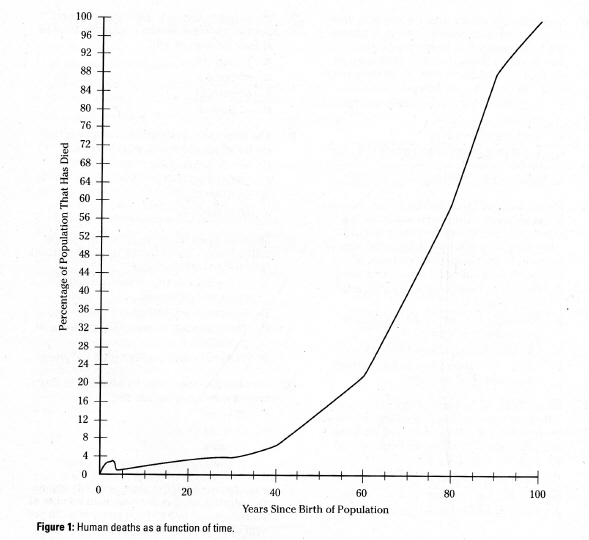
|
|
|
7.
|
According to Figure 1, approximately what percentage of the human population
lives to at least 80 years of age?
A. | 10 percent | C. | 60 percent | B. | 40 percent | D. | 80 percent |
|
|
|
8.
|
The increase in percentage of deaths is highest for which of the following
intervals?
A. | 0 to 20 years | C. | 40 to 60 years | B. | 20 to 40 years | D. | 60 to 80 years |
|
|
|
9.
|
Suppose infant mortality (children dying at birth or very shortly thereafter) is
eliminated. How will the graph change?
A. | The quick rise that is seen just after 0 years will disappear. | C. | The graph will be
less steep between 60 and 80 years. | B. | The graph will be higher at 20
years. | D. | The graph will rise
until past 120 years. |
|
|
|
10.
|
According to the graph, by what age do the largest number of people die?
A. | 25 years | C. | 75 years | B. | 45 years | D. | 95 years |
|
|
|
11.
|
For a person born the same year this population started, what is the maximum
number of years he could live and still observe an 80 percent chance of still being alive?
A. | 15 years | C. | 55 years | B. | 35 years | D. | 80 years |
|
|
|
Passage 3A radioactive substance is one that contains atoms
whose nuclei change into other types of atomic nuclei. For example, a uranium nucleus can lose two
protons and two neutrons and become a thorium nucleus. Atoms of some radioactive substances change
more frequently than others. Over time, the rate of change for any substance slows as a greater
percentage of atomic nuclei change to a final, more stable state. Devices can measure the number
of atomic changes that take place at a given time. Each of these changes is commonly called a
disintegration Table 1 and Table 2 show the disintegration rates for two unknown substances.
|
|
|
12.
|
About how many millicuries will be measured from Substance B after 20
hours?
|
|
|
13.
|
If Substance A originally had 10,000,000 radioactive atoms, how many atoms are
present at 15 hours?
A. | 666,667 | C. | 3,333,333 | B. | 1,250,000 | D. | 5,000,000 |
|
|
|
14.
|
When is the disintegration rate of Substance B 1,500 millicuries?
A. | at about 2 hours | C. | at about 3 hours | B. | at exactly 2 hours | D. | at exactly 3
hours |
|
|
|
15.
|
The half-life of a radioactive substance is the time it takes for half of the
radioactive atoms to disintegrate. Which substance has a shorter half-life?
A. | Substance A, because only 50 millicuries are present after 10 hours | C. | Substance B,
because the disintegration rate fell to half its original value in only 4 hours, instead of 5
hours | B. | Substance A, because it will all be gone after 25 hours | D. | Substance B, because it was measured for only
16 hours instead of 20 |
|
|
|
16.
|
Radioactive substances are potential health hazards. The particles emitted from
radioactive substances can damage parts of the human body. Humans should take great care to limit the
amount of radioactivity to which they are exposed. Which of the following is safest for a human to
handle?
A. | Substance A after 5 hours | C. | Substance B after 8
hours | B. | Substance A after 20 hours | D. | Substance B after 16 hours |
|
|
|
Passage 4
When sunlight heats the earth’s surface, much
of that energy is radiated back to the atmosphere.Although some of this re-radiated energy escapes to
space, a significant amount of it is reflected back tothe earth’s surface by molecules in the
atmosphere. These molecules -- water, nitrous oxide, methane, and carbon dioxide —- trap
re-radiated energy as glass in a greenhouse does and warm the earth.Hence, the term “greenhouse
effect” has been used to refer to the warming of the earth caused by the gases’ keeping
heat within the earth’s atmosphere.
Scientists agree that the greenhouse effect results in
higher temperatures on earth but disagreeas to whether recent increases in atmospheric carbon dioxide
will lead to undesirable global warming. Two scientists discuss this possibility.
Scientist
1
Ancient ice cores from Antarctica indicate that the concentration of carbon dioxide in the
atmosphere and global mean temperatures have followed the same pattern of fluctuations in levels over
the past 160,000 years. Therefore, the increase in atmospheric carbon dioxide concentration from 280
parts per million to 360 parts per million that has occurred over the past 150 years points to
significant and detrimental climatic changes in the near future. The climate has already changed: the
average surface temperature of the earth has increased 0.6°C in the past hundred years, with the
ten hottest years of that time period all occurring since 1980. Although 0.6°C may not seem
large, changes in the mean surface temperature as low as 0.5°C have dramatically affected crop
growth in years past. Moreover, computer models project that surface temperatures will increase about
2.0°C by the year 2100 and will continue to increase in the years after even if concentration of
greenhouse gases is stabilized by that time. If the present trend in carbon dioxide increase
continues, though,carbon dioxide concentration will exceed 1,100 parts per million soon after 2100
and will be associated with a temperature increase of approximately 10.0°C over the present mean
annual global surface temperature.
Scientist 2
The observed increases in minor
greenhouse gases such as carbon dioxide and methane will not lead to sizeable global warming. Water
vapor and clouds are responsible for more than 98% of the earth’s greenhouse effect. Current
models that project large temperature increases with a doubling of the present carbon dioxide
concentration incorporate changes in water vapor, clouds, and other factors that would accompany a
rise in carbon dioxide levels. The way these models handle such feedbackfactors is not supported by
current scientific knowledge. ln fact, there is convincing evidence that increases in carbon dioxide
concentration would lead to changes in feedback factors that would diminish any temperature increase
associated with more carbon dioxide in the atmosphere. The climatic data for the past hundred years
show an irregular pattern in which many of the greatest jumps in global mean temperature were too
large to be associated with the observed increase in carbon dioxide. The overall increase of
0.45°C in the past century is well under what the models would have predicted given the changes
in carbon dioxide concentration. As with the temperature models, recent increases in atmospheric
carbon dioxide have not risen to the extent predicted by models dealing solely with carbon dioxide
levels. The rate of carbon dioxide concentration increase has slowed since 1973. Improved energy
technologies will further dampen the increase so that the carbon dioxide concentration will be under
700 parts per million in the year 2100.
|
|
|
17.
|
Which of the following is an assumption madeby Scientist 1?
A. | Feedback factors have little effect on the magnitude to which increased carbon
dioxide will increase temperature. | C. | A rise in the global mean temperature of 1.0°C is not
significant. | B. | Humans will not be able to limit their activities that contribute to rising carbon
dioxide levels | D. | Temperature
fluctuations will match carbon dioxide changes when carbon dioxide changes are
abrupt. |
|
|
|
18.
|
A scientific article stated that “Scientists will soon develop computer
models that accurately account for feedback factors.” Which of the scientists’
viewpoints, if any, is(are) consistent with this statement?
A. | Scientist 1 only. | C. | Both Scientists 1 and 2. | B. | Scientist 2
only. | D. | Neither Scientist 1
nor 2. |
|
|
|
19.
|
Which of the following is the most likely reason that the two scientists present
different figures for the temperature rise that has occurred over the past hundred years?
A. | lt has been difficult to determine the mean global temperature with complete
accuracy. | C. | Scientist 1 notes that all ten of the hottest years in the last hundred years have
come since 1980. | B. | Scientist 2 uses figures that do not take account of the rise in atmospheric carbon
dioxide. | D. | It has not been
established that global warming is a threat to the earth. |
|
|
|
20.
|
Indicative of rising temperatures, a large block of the Larson B Ice Sheet in
Antarctica recently broke off, raising water levels around the world and increasing the vulnerability
of coastal areas to flooding. In light of this information, which of the following predictions would
be most consistent with Scientist 1’s viewpoint?
A. | Feedback factors will retard the future rate of ice sheet
disintegration. | C. | The breakup of the ice sheet will minimize global warming. | B. | The amount of ice
that will break off will double with a doubling of atmospheric carbon dioxide. | D. | Coastal areas will be more prone to flooding in
the next hundred years. |
|
|
|
21.
|
Scientists l and 2 would most likely agree with which of the following
statements about atmospheric carbon dioxide levels?
A. | Increasing carbon dioxide levels affect other factors. | C. | The rate of increase in carbon
dioxide levels will rise throughout the next hundred years | B. | Humans will never be
able to stabilize atmospheric carbon dioxide levels | D. | Carbon dioxide levels are directly linked to
temperature.
|
|
|
|
22.
|
The manner in which Scientist l presents her claim about the significance of
increased global temperatures over the past hundred years is most vulnerable to which of the
following criticisms?
A. | The carbon dioxide increases that she presents have taken place over the past 150
years. | C. | She does not specify whether the change in crop growth she cites was caused by an
increase or decrease in temperature. | B. | She does not specify which years since 1980
have been hottest. | D. | The
figures she presents for temperature increases over the next hundred years are greater than the
figure for the past hundred years. |
|
|
|
23.
|
Scientist 2 implies the truth of which of the following statements?
A. | Humans will be able to adapt to any problem produced by global warming | C. | Atmospheric carbon
dioxide levels will never reach 1,100 parts per million. | B. | A change in
atmospheric water vapor could significantly affect global temperatures. | D. | Atmospheric carbon dioxide levels will
eventually stop increasing. |
|